Kuramoto oscillators: an open time source
A clock built on one oscillator stops when that oscillator stops. jev_kuramoto takes a different approach. It's four phase oscillators on SkyWater SKY130 that pull toward one another, and it emits a tick only when three of them agree. The block is open source, it has passed signoff, and it serves as the timebase for the whole jev chipset.
The mesh
The interactive bench above is a mesh of time sources. Each oscillator gets its own natural frequency, spread a few percent around one turn per step. On every step, each one advances, and the sine of its phase difference from every other oscillator pulls on it. While the mesh is out of step, each oscillator slows down, so the ones ahead wait for the rest to catch up.
The arrow in the ring is the order parameter, R. When R is near 0, the phases are scattered. When R is near 1, they're locked together. The run uses a fixed seed, so the same settings always draw the same mesh.
What the silicon does
The signed-off block holds four of those oscillators, each stored as a 32-bit phase word where one full turn is 2^32. After reset, the phases start at 0, 5/16, 10/16, and 15/16 of a turn. Their frequencies are 0x10000000, 0x10F5C28F, 0x0F333333, and 0x107AE148, which works out to about one turn every 16 clocks, each a few percent apart.
On each clock, a node adds three things: its own frequency, one-sixteenth of the wrapped phase error from each neighbor it's still listening to, and one 256th of that error folded into its frequency. A node that's ahead of all its neighbors, and isn't locked to an outside source, advances at half speed.
Six near bits mark which pairs sit within a sixteenth of a turn of each other, 22.5 degrees. Quorum means at least three nodes are all near each other. Coherent means all six pairs are near. If a node is near nobody while a quorum holds, it's treated as a fault, and the listen tables drop it from the coupling. The strobe table then picks the lowest-numbered healthy node, and ec_tick fires on that node's wrap, but only while quorum holds. That tick is the time source.
| Spec | Value |
|---|
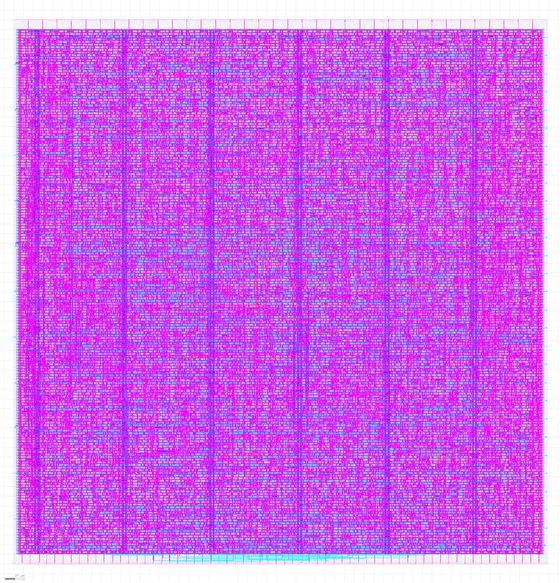
| Die | 548.32 × 560.32 µm |
| Setup slack | 0.715 ns |
| Hold slack | 0.194 ns |
| Corner | max_ss_100C_1v60 |
| Clock target | 25 ns |
Everything is in the kuramoto-oscillator-sky130a repository: the LEF, the Verilog, the VHDL, sixteen self-checking test vectors, and the WGSL reference model of the mesh.
Why a quorum
Three out of four is enough to ignore one bad oscillator and still produce a tick. The bench shows the same kind of agreement at larger scale. Turn up the coupling and the order parameter climbs. At zero coupling, each oscillator keeps its own time and R stays low.