
Spec to silicon.
We cover architecture, RTL, verification, and physical design in one firm, with a single team accountable from start to finish.
Encryptid Systems takes hard problems from written specification to verified, tape-out-ready silicon. We design for defense programs and for quantum-inspired computing on classical hardware.
Security-first engineering, from the first requirement to the final layout.
We cover architecture, RTL, verification, and physical design in one firm, with a single team accountable from start to finish.
Every design assumes an adversary, which is how our offensive-security background shapes the work.
We bring quantum-inspired methods to conventional chips you can fabricate and deploy today.
A program brings the function, the clock, the pins, and the shuttle frame. We lower that specification, harden it on the jev class, and return the layout with the signoff report. The published set is the five blocks below.
| Part | Function | Die, µm | Setup, ns | Hold, ns |
|---|---|---|---|---|
| jev_kuramoto | Four phase oscillators forming a quorum timebase | 548.32 × 560.32 | 0.715 | 0.194 |
| jev4 | 4-bit controller, one clock per instruction byte | 236.535 × 247.255 | 6.517 | 0.930 |
| jev_dot_pipe | 32-bit dot product with four multiply-accumulates | 366.545 × 377.265 | 4.492 | 0.894 |
| jev_dot_spi | The dot-product engine behind an SPI slave | 450.675 × 461.395 | 2.220 | 0.827 |
| jev_mesh_2x2 | Four engines with flits, partials, and row sums | 959.0 × 985.0 | 2.774 | 0.840 |
All blocks passed SKY130A signoff on October 4, 2026. Setup and hold are worst-case slack at the max_ss_100C_1v60 corner. Every block has zero slew, capacitance, and fanout violations and zero errors in route DRC, Magic DRC, KLayout DRC, and LVS. The clock target is 25 ns.
Instructions and data travel separate paths. Instructions are carried by a spatial netlist, while weights, activations, partial sums, and row sums each move on their own. The published chipset is made up of the five signed-off blocks.
jev4 sequences the work, and jev_dot_pipe computes a single dot product modulo 2³². jev_dot_spi exposes that engine over SPI, while jev_mesh_2x2 arranges several engines into an array. jev_kuramoto is four oscillators that agree by a quorum of three.
Open kit
The jev class is our open process design kit. A block joins the class once it closes signoff on SkyWater SKY130A with the sky130_fd_sc_hd standard cells. Each block lives in its own repository under github.com/EncryptidSystems.
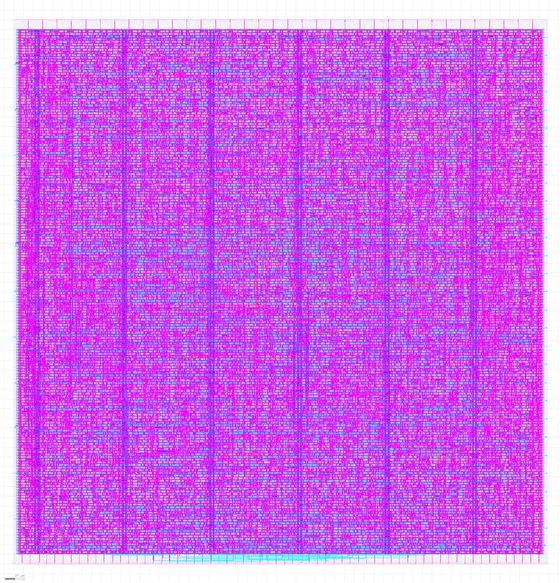
Four 32-bit phase oscillators sit at the corners of the timebase. On every clock, each oscillator advances at its own frequency and is pulled toward the other three. Quorum means three of the four are near each other. Die 548.32 × 560.32 µm, setup 0.715 ns, hold 0.194 ns.
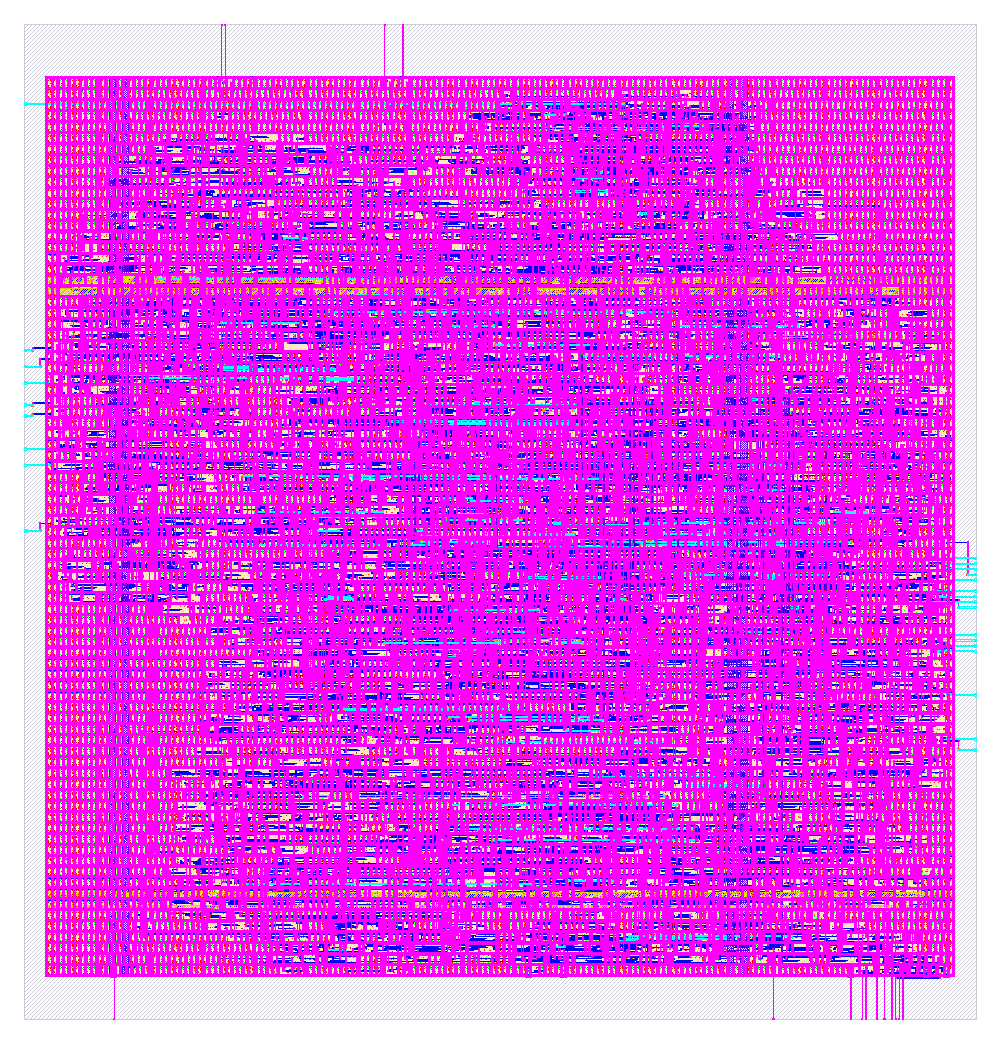
A 4-bit processor whose whole instruction set runs as a single clocked circuit. It executes one clock per instruction byte from a 256-byte program ROM. Die 236.535 × 247.255 µm, setup 6.517 ns, hold 0.930 ns.
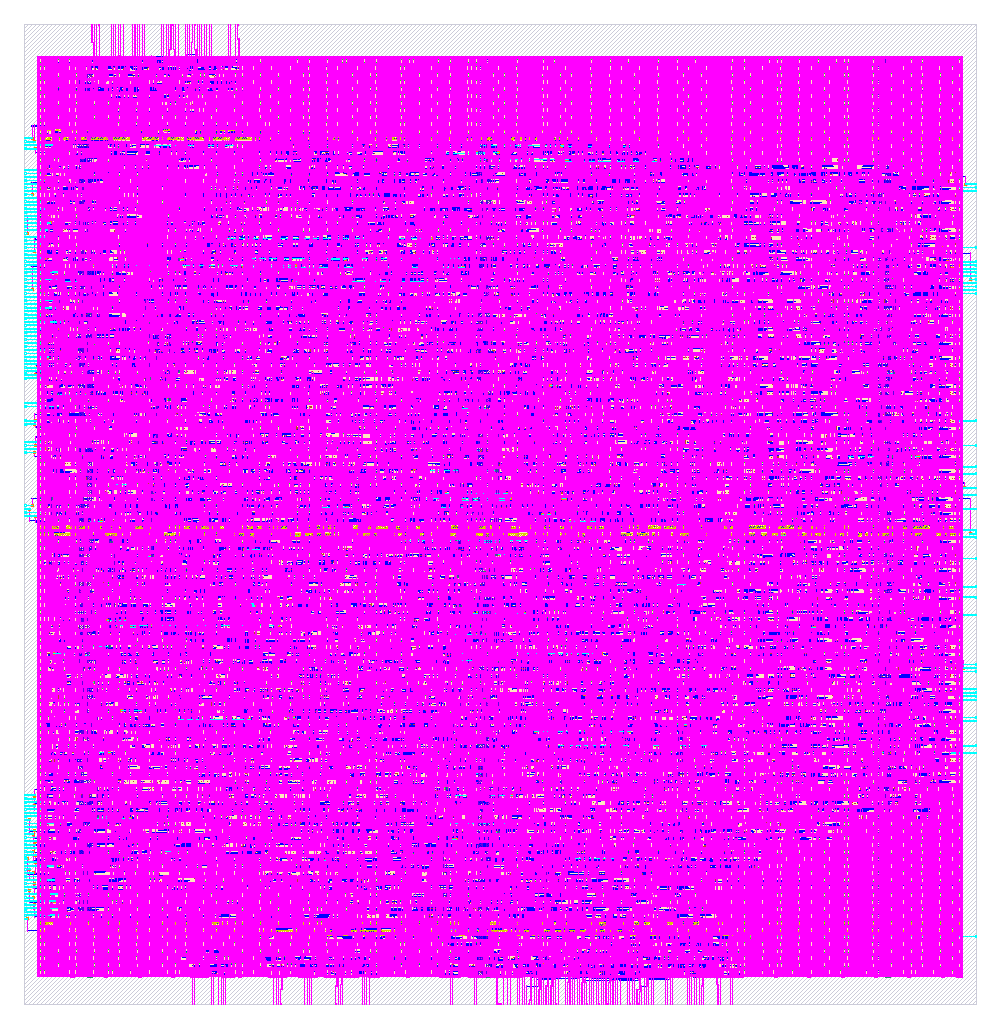
A 32-bit dot product built from four multiply-accumulates, one per clock, with the sum taken modulo 2³². Die 366.545 × 377.265 µm, setup 4.492 ns, hold 0.894 ns.
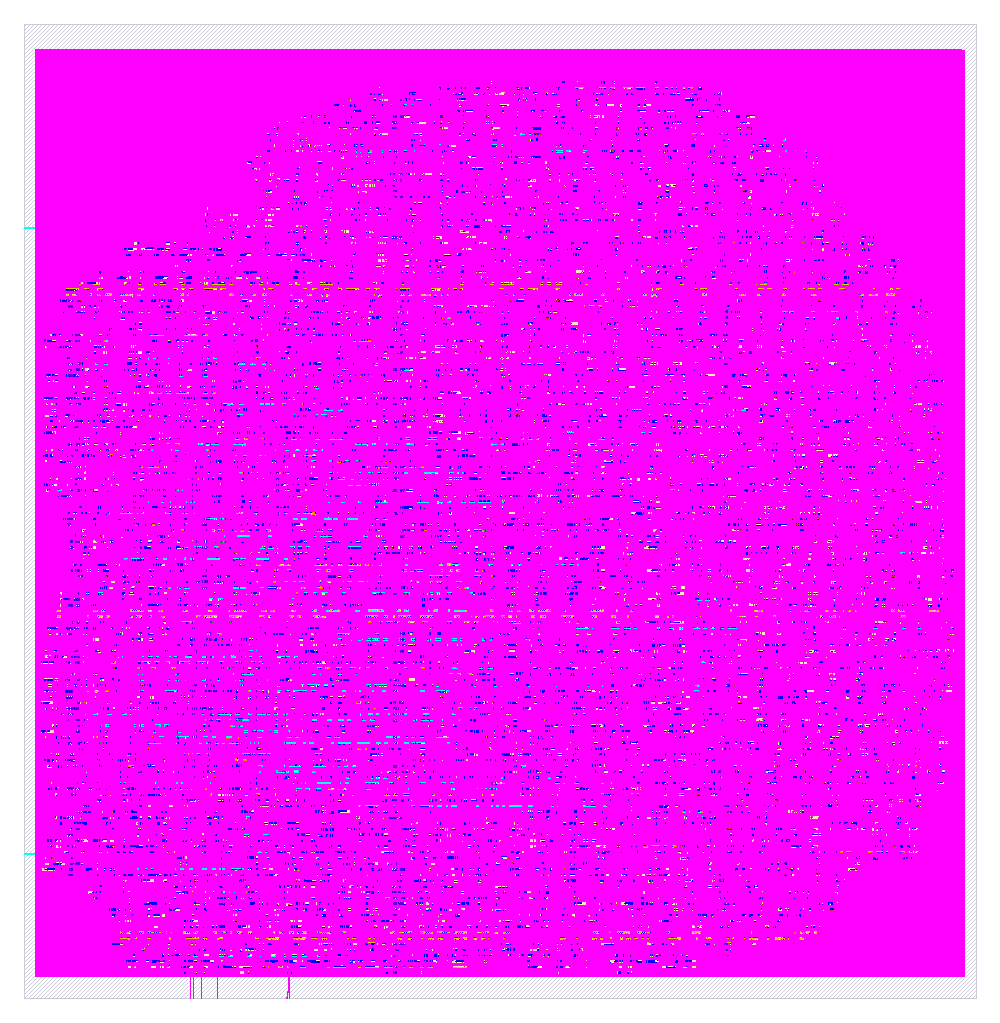
The same dot-product engine placed behind an SPI slave and a register file. The SPI clock runs at no more than one-eighth of the chip clock. Die 450.675 × 461.395 µm, setup 2.220 ns, hold 0.827 ns.
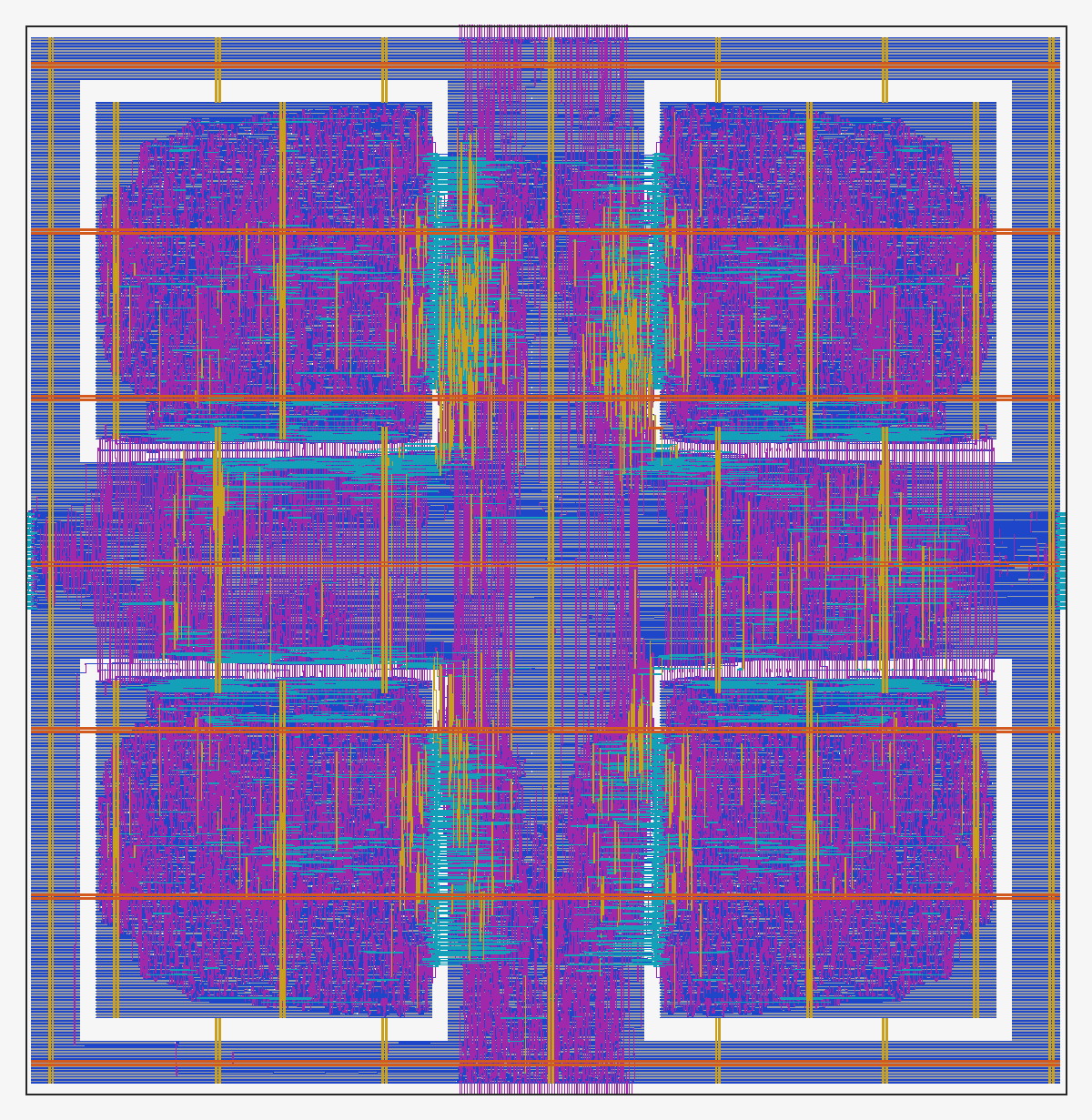
Four dot-product engines with a weight file, north and south flit ports, partial sums coming in from the west, and row sums going out to the east. Two-slot buffers sit on the south and east sides. Die 959.0 × 985.0 µm, setup 2.774 ns, hold 0.840 ns.
Method
Every block moves through the same six gates. Blocks that have cleared all six include jev_kuramoto, jev4, jev_dot_pipe, jev_dot_spi, and jev_mesh_2x2.
We write the function, clock, pins, and shuttle frame once, as a single source of truth.
We translate that specification into a WGSL reference model, Verilog, and VHDL, and all three must match cycle for cycle.
We synthesize with Yosys and then do a pre-run check. The block has to fit a site-snapped die, every net except the clock has to stay within the fanout limit, and we record a slew estimate at the slow corner.
We use OpenROAD for placement, clock-tree synthesis, and repair, all at the slow corner, max_ss_100C_1v60.
We run static timing, route DRC, Magic DRC, KLayout DRC, and LVS. A block is published only after every check is clean.
The shuttle frame is part of the specification, so we measure the die against it before calling the layout a submission. If a route only closes because congestion was allowed, it doesn't count as a part that works.
Every program starts with a specification.